
Why Do I Lose Myself While Trying to Understand Other People?


There are conversations that continue long after the words themselves have ended. They accompany us home, return while we're making dinner, or quietly resurface as we prepare for bed. A sentence we wish we had phrased differently comes back to mind. A pause suddenly feels significant. We begin wondering whether we misunderstood another person's meaning, whether our own reaction was fair, or whether we somehow failed to notice something important.
Experiences like these are woven into ordinary life. They are often born from qualities we value deeply: curiosity, compassion, humility, and a sincere desire to understand another human being well. Few things strengthen a relationship more than the willingness to listen carefully before drawing conclusions.
Yet there are occasions when that same generosity gradually changes direction. Instead of helping us understand another person's experience, it begins to draw our attention farther and farther away from our own.
The change is rarely dramatic enough to announce itself. It gathers quietly over many conversations, each one asking for a little more accommodation, a little more explanation, or a little more patience than the last. Because the movement is gradual, we often notice its effects before we recognize the pattern itself.
When understanding becomes unbalanced
One of the remarkable capacities of the human mind is its ability to imagine another person's perspective. We can infer intentions, anticipate emotions, and wonder what an experience might feel like from someone else's point of view. This ability has helped families cooperate, communities endure, and friendships deepen across every culture we know.
Perspective-taking, however, was never meant to replace perspective-keeping.
As our attention becomes increasingly occupied with another person's inner world, there are moments when our own thoughts, feelings, and observations begin to receive less attention than they deserve. We become skilled interpreters of another person's experience while growing less certain of our own. The questions we ask ourselves begin to change. Rather than wondering, What happened? we find ourselves asking, Was I expecting too much? Rather than considering whether something felt right, we begin searching for reasons our discomfort may not be justified.
Many people recognize this movement only in hindsight. Looking back, they realize they had become exceptionally attentive to another person's experience while gradually becoming less attentive to their own.
What careful observations reveal
One of the quiet disciplines of thoughtful living is learning to distinguish observations from interpretations. The two often arrive together, yet they are not the same. Observations begin with what can be seen. Like, when a conversation lingers in your thoughts for the rest of the afternoon. You notice yourself replaying it several times before the day is over. You hesitate before expressing a concern because preserving harmony feels easier than risking misunderstanding. Another person's disappointment remains vividly present, while your own experience becomes increasingly difficult to describe.
None of these observations tells us what the underlying meaning is. They simply offer a place from which understanding can begin to creep in. Interpretation comes later, informed by reflection, experience, and—when available—careful research.
That order matters. We often gain far more insight by observing patiently than by rushing to explain what we think we already know.
What current research suggests
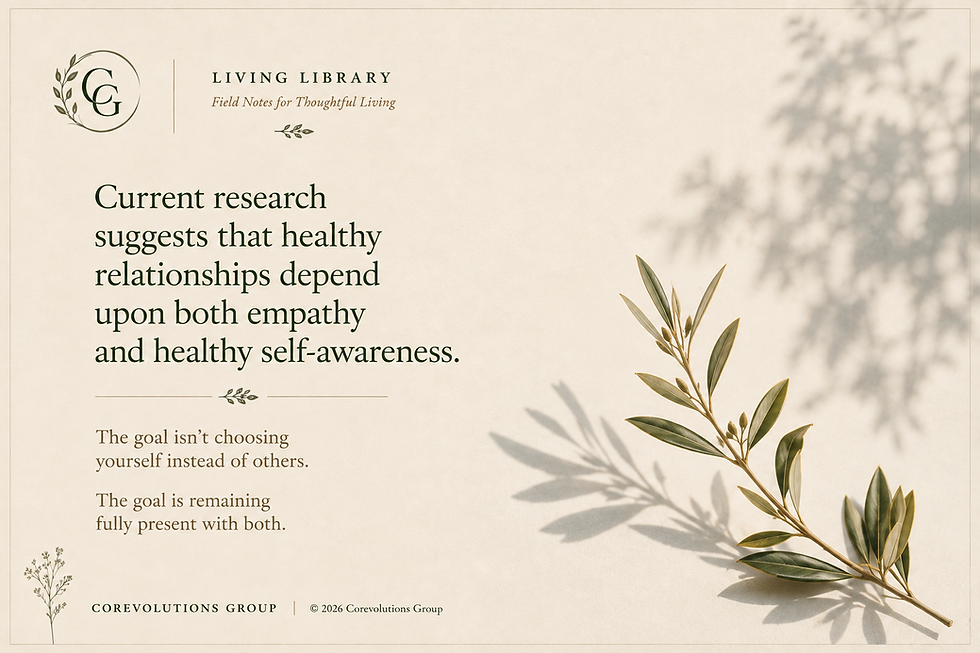
Across psychology, neuroscience, and relationship science, researchers have increasingly distinguished empathy from emotional absorption. Empathy allows us to appreciate another person's experience while remaining grounded in our own. Emotional absorption, by contrast, can gradually blur those boundaries, making it difficult to distinguish another person's emotions, expectations, or responsibilities from our own. Studies exploring self–other differentiation, self-compassion, and healthy interpersonal boundaries suggest that sustainable relationships are supported not by less compassion, but by compassion that remains connected to an enduring sense of self.
Perhaps this helps explain why many thoughtful people feel unexpectedly exhausted in relationships they genuinely value. The difficulty may not lie in caring too much. It may lie in carrying more than was ever ours to carry.
Returning to yourself
Returning to yourself does not require withdrawing from other people. It does not ask us to become less generous, less curious, or less willing to listen. Instead, it invites us to include our own experience within the conversation rather than quietly setting it aside.
That practice begins in remarkably ordinary ways. We notice what we are feeling before explaining it away. We become curious about our own experience with the same patience we extend to someone else's. We discover that honesty and kindness are not opposing virtues but companions, each helping the other become more complete.
Healthy relationships do not ask one person to disappear so another can be understood. They make room for two lives, two perspectives, and two unfolding experiences, each worthy of thoughtful attention.
Continue Growing
This reflection offers only one view into a much broader landscape. The Living Library Article Why Do I Lose Myself While Trying to Understand Other People? explores t
his question through interdisciplinary research, reflective practices, guided exercises, and a deeper examination of empathy, boundaries, communication, and self-awareness. If today's reading resonated with you, I invite you to continue exploring.



Comments